
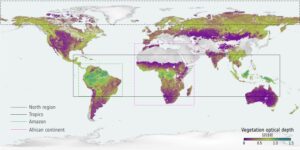
Data from ESA’s Soil Moisture and Ocean Salinity (SMOS) mission can be used to estimate how much carbon is stored in forests. (Credit: ESA (Source: Boitard, S. et al, 2025))
Forests play a central role in the global carbon cycle as trees store carbon in their trunks, branches, roots and leaves. However, climate change and human activities can change the ability of forests to absorb carbon and the annual changes in these carbon stocks are highly variable in space and time around the globe. That’s why having continuous observations of the evolution of forest biomass over a long period is important for monitoring this essential climate variable.
A study published earlier this year in Earth System Science Data analysed a method for estimating forest biomass over a 15-year period using vegetation optical depth (VOD) data from SMOS. This measurement quantifies the opacity of a layer of vegetation, serving as a reliable proxy for above-ground biomass. Based on observations from 2011 to 2025, the study enhances our understanding of how SMOS-derived VOD can be used to monitor carbon stored in forest ecosystems.
CAPTION
Data from ESA’s Soil Moisture and Ocean Salinity (SMOS) mission can be used to estimate how much carbon is stored in forests. (Credit: ESA (Source: Boitard, S. et al, 2025))
