
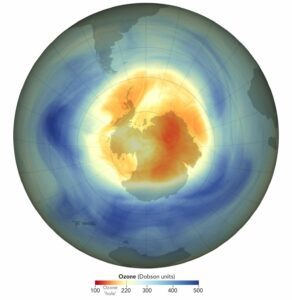
A map shows the size and shape of the ozone hole over the South Pole on the day of its 2025 maximum extent. Moderate ozone losses (orange) are visible amid areas of more potent ozone losses (red). Scientists describe the ozone “hole” as the area in which ozone concentrations drop below the historical threshold of 220 Dobson units. (Credit: NASA Earth Observatory image by Lauren Dauphin, using data courtesy of NASA Ozone Watch and GEOS-5 data from the Global Modeling and Assimilation Office at NASA GSFC)
While continental in scale, the ozone hole over the Antarctic was small in 2025 compared to previous years and remains on track to recover later this century, NASA and the National Oceanic and Atmospheric Administration (NOAA) reported. The hole this year was the fifth smallest since 1992, the year a landmark international agreement to phase out ozone-depleting chemicals began to take effect.
At the height of this year’s depletion season from Sept. 7 through Oct. 13, the average extent of the ozone hole was about 7.23 million square miles (18.71 million square kilometers)—twice the area of the contiguous United States. The 2025 ozone hole is already breaking up, nearly three weeks earlier than usual during the past decade.
