
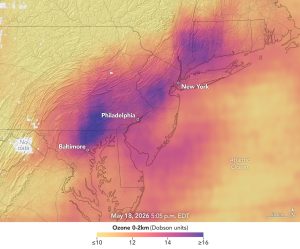
 New observations from NASA’s TEMPO mission are providing an unprecedented look at how air pollution changes throughout the day across the northeastern United States. Recent imagery captured elevated ozone concentrations stretching from New York City to Washington, D.C., demonstrating the ability of the instrument to track atmospheric conditions with remarkable detail.
Unlike previous satellite missions that typically observed a location once per day, TEMPO continuously monitors air quality across North America during daylight hours. This capability allows scientists to observe how pollution evolves over the course of a day, providing valuable insight into the relationship between emissions, weather patterns and public health.
In the accompanying image, TEMPO detected elevated ozone concentrations in an area extending from New York City to Washington, D.C., on May 18, 2026. Note the map depicts beta data that’s not optimized for operational use.
Researchers say the mission will improve understanding of ozone formation, wildfire smoke transport and other air-quality challenges affecting millions of people. The data also can support environmental agencies and local governments as they work to address air-pollution concerns and evaluate mitigation strategies.
Image credit: NASA Earth Observatory/Michala Garrison
