
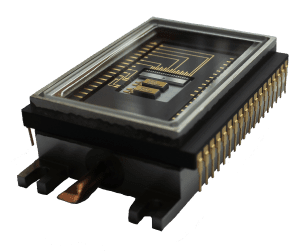
Teledyne e2v’s detector consists of a 16- by 16-pixel CCD with a novel storage region that accumulates the signal from several successive laser pulses. The detector is housed in a hermetically sealed package with an integrated Thermoelectric Cooler that uses the Peltier effect to transfer heat away from the sensor.
Teledyne e2v provided a key component for the highly customized ultraviolet laser detector for the Atmospheric Laser Doppler Instrument (ALADIN) on the European Space Agency’s Aeolus Satellite, which launched on Aug. 22, 2018.
Contracted by Airbus Defence & Space, Teledyne e2v developed a unique Charge Coupled Device (CCD) type detector specifically for the mission. The CCD69 ultraviolet detector is part of a unique satellite named Aeolus, which will gather wind data profiles of Earth to improve the accuracy of global weather forecasts.
ALADIN works by emitting an ultraviolet laser beam through Earth’s atmosphere and measuring the reflected return signal from particles in the atmosphere. Teledyne e2v, in collaboration with Airbus Defence & Space and ESA, developed an innovative type of detector that simultaneously measures the distance of the returned ultraviolet laser pulse to resolve the altitude of aerosols in the atmosphere as well as the Doppler shift that equates to the wind speed at each altitude.
The returned signal is typically extremely weak, but the detector can add together a number of returned pulses to improve the accuracy of measurements. Aeolus is the first satellite of its kind to utilize this type of technology in space.
