
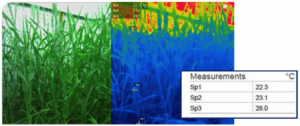
A simulated field density growth of wheat show (from left to right) a visual image, a thermal image and measurements. The plant’s temperature varied from 22 ± 1.5°C in the stem to 32.5± 1 °C in the most apical part of the leaves.
The departments of Entomology and Ecology at Penn State University made it their mission to conduct research on insects that will improve human health, quality of life, and the sustainability of our food and ecosystems.
Research in the Departments of Entomology and Ecology addresses diverse questions and uses a wide variety of experimental approaches and methodologies, including thermal imaging, to discover more about the lives of insects. Temperature is one of the most important environmental factors affecting the growth and development of insects. Microclimatic conditions on the host plant are especially important for herbivorous insects; thermal gradients often govern the distribution of insects on their host plant.
At Penn State, an experiment was set up to identify the thermal gradient on wheat (Triticum aestivum L.). Thermographic measurements were taken with a FLIR T650sc thermal-imaging camera with a 15mm lens and an emissivity value of 0.90. The wheat plant was located in a growth chamber, with controlled humidity, light, temperature and wind speed, which ensured a homogenous airflow and avoided fluctuations. The FLIR camera was exposed to the environmental conditions in the incubator for about two hours before the experiment, and the plants were acclimatized 24 hours before pictures were taken. A set of 10 pictures were taken per plant, with one meter distance between the plants and the camera. The thermal gradient was assessed on plants under simulated conditions of field density and for individual plants.
