
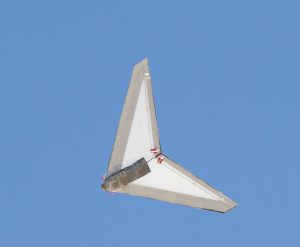
The WHAATRR test glider recently won an NASA technology grant and could prove an economical addition to weather monitoring. (Credit: NASA Photo/Lauren Hughes)
More accurate, immediate and economical information on severe weather phenomena such as hurricanes soon could be available thanks to the Weather Hazard Alert and Awareness Technology Radiation Radiosonde (WHAATRR) Glider. According to project manager Scott Wiley, the vehicle could potentially save the National Weather Service up to $15 million a year compared to current methods.
In addition to NASA and the National Weather Service, the WHAATRR Glider could benefit the National Oceanic and Atmospheric Administration and potentially serve as an airborne sciences platform, added Wiley. Data obtained from such gliders could reduce costs incurred from unnecessary airline delays and potentially save aircraft and lives.
“It could fill a tremendous need in the weather community,” said Wiley.
Sensors, instrumentation and flight-control software and hardware will be prepared for the aircraft’s ultimate test in the early development phase: a drop from 100,000 feet altitude and remotely piloted to a predetermined destination.
