
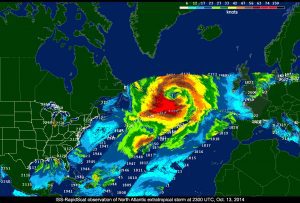
An image shows ISS-RapidScat data from a North Atlantic extratropical cyclone, as seen by the National Centers for Environmental Prediction Advanced Weather Interactive Processing System used by weather forecasters at NOAA’s Ocean Prediction Center. (Credit: NASA/JPL-Caltech/NOAA)
On Sept. 21, 2014, NASA scientists and engineers launched RapidScat toward the orbiting International Space Station, 250 miles above Earth’s surface, with a few objectives in mind: improve weather forecasting on Earth, provide cross-calibration for all international satellites that monitor ocean winds, and improve estimates of how ocean winds change throughout the day.
Following the 2009 end of the QuikScat mission (a similar instrument), NASA was challenged to quickly create a replacement device, as QuikScat data helped meteorologists predict weather patterns and prepare for large storm systems for more than a decade. Using the existing data and power services of the station and hardware initially built as a spare for QuikScat, RapidScat greatly improved the timeliness of data transmissions and the potential for cross-calibration of other sensors designed to measure sea-surface winds.
Because of its ability to monitor weather systems around the world, RapidScat played a vital role in storm prediction and allowed maritime and air traffic time to avoid potentially dangerous weather conditions. RapidScat’s radar technology used microwaves, bounced off the ocean’s surface, to determine wind speed and direction.
RapidScat completed its successful two-year mission, outlasting its original decommission date before suffering a power loss in mid-August 2016. For a more in-depth look at the RapidScat mission, visit http://winds.jpl.nasa.gov/missions/RapidScat/.
