
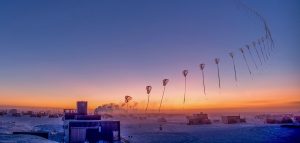
This time-lapse photo from Sept. 10, 2018, shows the flight path of an ozonesonde as it rises into the atmosphere over the South Pole from the Amundsen-Scott South Pole Station. Scientists release these balloon-borne sensors to measure the thickness of the protective ozone layer high up in the atmosphere. (Credit: Robert Schwarz/University of Minnesota)
The ozone hole that forms over the Antarctic each September is primarily driven by two factors: the amount of ozone-destroying chlorine in the polar stratosphere and the availability of ice crystals in stratospheric clouds for the chlorine to bind to. This year, the super-cold stratospheric temperatures measured by NOAA and NASA meant conditions were ripe for the development of ice clouds—and a big ozone hole.
But the size of the 2018 ozone hole seen by NASA satellites was just a little larger than average, covering 8.83 million square miles (almost three times the size of the contiguous United States). That’s because chlorine levels have been falling thanks to a 30-year-old global environmental treaty known as the Montreal Protocol.
“This year’s colder temperatures would have given us a much larger ozone hole if chlorine was still at levels we saw back in the year 2000,” said Paul A. Newman, chief scientist for Earth Sciences at NASA’s Goddard Space Flight Center in Greenbelt, Md.
Weather conditions allowed for near-complete elimination of ozone in a deep, 3.1-mile layer over the South Pole, NOAA scientist Bryan Johnson said. “Even with this year’s optimum conditions, ozone loss was less severe in the upper altitudes,” he said.
Ozone, comprised of three oxygen atoms, occurs naturally in exceedingly small amounts. If compressed into its pure form, all the ozone in a column of atmosphere extending from the ground to space would be about as thick as two pennies stacked one on top of the other. Although ozone’s presence is small, in the stratosphere, roughly 7 to 25 miles above Earth’s surface, ozone acts like sunscreen, shielding the planet from ultraviolet radiation that can cause skin cancer and cataracts, suppress immune systems and damage plants.
