
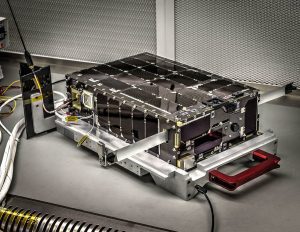
Dellingr is a six-unit (6U) CubeSat, meaning its volume is approximately six liters. The satellite’s exterior is lined with solar panels. (Credit: NASA’s Goddard Space Flight Center/Bill Hrybyk)
Construction of NASA’s Dellingr CubeSat is complete, and the satellite now is ready for environmental testing. Named for the god of dawn in Norse mythology, Dellingr will study the ionosphere—the outer region of Earth’s atmosphere populated by charged particles ionized by incoming solar radiation and magnetospheric particle precipitation.
Slightly larger than a cereal box, Dellingr carries three payloads: a miniaturized mass spectrometer and two no-boom magnetometer systems. These instruments will help Dellingr create a chemical and electromagnetic profile of Earth’s outer atmosphere, an important component of the complex, interconnected sun-Earth system that can drive changes in space weather and impact satellites.
