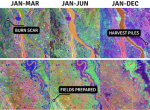
For firefighters, each new blaze presents different challenges. Where to get water... the boundaries between private and public property.. access roads and other details can be crucial to getting control of a fire. To make that easier, the Forest Service and other agencies are building their own Google Earth program. Read More
A Beidou systems satellite is now believed to have experienced past interference from a complex electromagnetic environment, which cut off signal transmissions in 2007, People's Daily reported. Since 1994, Beidou has grown into a Chinese-made satellite navigation system consisting of 14 satellites, and covering the Asia-Pacific area as of late 2012. The further development of its navigation system will see the planet covered by 2020 with at least 16 new satellites joining the group. Read More
A Silicon Valley startup named Skybox is launching a fleet of imaging satellites that are cheap, small, and ultra-efficient. Their up-to-the-minute snapshots of the planet will give us data that could upend industries, transform economies—even predict the future. Read More
The National Geospatial-Intelligence Agency (NGA) wants to transform the way it handles geospatial information, and the agency is asking industry for feedback on how it might proceed. The NGA, charged with providing time-sensitive navigational and aeronautical data to support the Defense Department, wants to render its existing geospatial holdings textually and in Open Geospatial Consortium (OGC) formats within 28-day production cycles, according to a June 12 request for comment. Read More
Given the recent NSA revelations, there may not be anything you can do about the government monitoring certain private data (other than abandoning services like Gmail or Skype). But what about the security cameras watching you in cities like New York or London? A new crowdsourcing mapping app called Surv gives city dwellers a way to prepare themselves for that kind of privacy infringement by mapping where those cameras are and what they’re used for. Read More
Each second the world's population grows by two more people, and by 2050, food production must increase by at least 70 percent to keep pace. Unfortunately, about half of the world's food is never consumed due to inefficiencies in the harvesting, storage and delivery of crops. Even in developed nations, about 30 percent of purchased food ends up going to waste, and supply-chain inefficiencies only exacerbate the problem. Read More
A Russian Soyuz 2-1B launch vehicle has lofted the second Persona reconnaissance satellite into space on Friday. The launch was conducted at 18:37 GMT from launch pad 43/4 at the Plesetsk Cosmodrome in northern Russia, with a successful spacecraft separation confirmed by the Russian military. Read More
Agricultural biodiversity is the basis of our life on Earth. It is also the basis of healthy and resilient ecosystems. Yet it is under threat. Biodiversity provides more options for dietary diversity, can help smallholder farmers grow more food and earn more income, while protecting the natural resource base upon which their—and our—lives depend. It is time to redesign farms as productive, healthy, resilient ecosystems that conserve diversity within a broad landscape that provides food. Read More
It appears that “drones” are here to stay. And Silicon Valley drone makers are going beyond military and spy applications, creating new environmental uses for unmanned aerial vehicles. "Our eyes are like the worst eyes in the animal kingdom,” Anderson says. “The cameras have been sort of crippled, to resemble the human eye. So we ‘un-cripple’ these cameras, to see the world the way an insect would see it." Read More
The Smart Citizen Kit looks to be one of the more polished efforts at building a distributed sensing and data aggregation platform. The kit is a microcontroller motherboard (wireless networking and Arduino-compatible in it’s own smart footprint), along with various sensor daughterboards. The Kickstarter sensor board is called the Ambient Board which stocks a handful of sensors for air composition, temperature, light intensity, sound levels, and humidity. More boards on the way for agriculture, health, EMF detection and other applications. Read More
Google Inc. has agreed to acquire map-software provider Waze Inc. for about $1.1 billion, a person with knowledge of the deal said, seeking to keep competitors such as Facebook Inc. from eroding its lead in mobile-navigation programs.The deal for Waze, based in Palo Alto, California, may be announced as early as tomorrow, said the person, who asked not to be named because the plans are private. Read More
Scientists have been in the field measuring the environmental impact of vast oilsands developments since spring 2012, but were doing the work under what amounted to a handshake deal between the two governments. This week’s deal could be the final step to bring scientific credibility to assessments of the environmental impact of many billions of dollars in industry activity. Read More
A Russian satellite launched last year to map the Arctic has stopped working, a space industry source told the Interfax news agency on Thursday, in the latest disappointment for the country's once-pioneering space program. The orbiter, Zond-PP, was the first of five Earth-mapping satellites being developed by Russia. Launched in July 2012, it was expected to have a three-year life span. Read More
Precisely measuring supplies of meltwater could help farmers in the US plan what they plant in order to battle a changing climate. "OUR water supply is always under threat." Like most farmers in California's fertile San Joaquin valley, Zachary Sheely is dependent on snowmelt from the Sierra Nevada mountains for his livelihood. But the snows have become sparse and inconsistent, complicating decisions on which crops to grow. "We are getting more and more years in a row with extreme conditions so the risk to our crops is huge," he says. Help could soon be at hand. A pair of airborne sensors developed by NASA, coupled with on-the-ground smartphone apps, could make the lives of farmers like Sheely a little easier. Read More
When China — along with Japan, South Korea, Singapore, India, and Italy — was granted permanent observer status in the Arctic Council last month, it left many experts wondering whether a paradigm shift in geopolitics is taking place in the region. Until recently, security issues, search and rescue protocols, indigenous rights, climate change, and other environmental priorities were the main concerns of the intergovernmental forum, which includes the eight voting states bordering the Arctic and several indigenous organizations that enjoy participant status. But the admission of China and other major Asian economic powers as observer states is yet another strong sign, experts say, that the economic development of an increasingly ice-free Arctic is becoming a top priority of nations in the region and beyond. Read More
FEMA has spent more than $185 million dollars in Vermont to assist with Tropical Storm Irene recovery. The total is significantly higher than any other sources of recovery funds. According to information compiled by VPR, towns, rather than the state, received the lion’s share of the money. Read More
In-Q-Tel, the intelligence community’s venture capital arm, tasked to ensure organizations like the CIA and NSA maintain a “mission advantage,” as their site puts it, has invested in some powerful technology which is now in the hand of companies with household names. Read More
If you think studying geography is memorizing the capital of South Dakota, think again. Spencer Baker, a geography student at Kent State University, just returned from Moore, Okla., where he helped map the destruction caused by the May 20 tornado, and waited out a second tornado, which touched down near his hotel Friday. Read More
Scientists with the Smithsonian Institution have discovered at least one new fish species at a deep reef off Curacao while conducting a yearlong project to gather data on temperature and biodiversity for monitoring climate change effects in the Caribbean. The discovery occurred in recent weeks off the southern edge of the Dutch Caribbean island as scientists used a submarine to explore depths up to 1,000 feet (305 meters). Read More
Google has introduced a new API for its Maps Engine, touted to enable developers to build "endless kinds of applications" all while hosted in the Internet giant's cloud. To recall, The Maps Engine is essentially the reincarnation of Google Earth Builder, which lets developers use Google's cloud infrastructure for storing and managing their own geospatial data and maps. Users can also use the service to share their custom Google Maps with other employees, clients, and the public-at-large. Read More
The Colorado Economic Development Commission has approved more than $8 million in tax incentives for three companies that have pledged to create or locate nearly 1,000 jobs in the state over the next five years. Longmont-based DigitalGlobe received approval for more than $4 million under the state's job-growth-incentive tax-credit program on Thursday in return for creating 505 jobs over the next five years, the most jobs that were promised. Read More
There are moves to roll out free satellite mapping services to all graziers across Australia. Currently, the Queensland Government is funding this service to graziers in North Queensland, but it could be rolled out nationally by the end of the year. Satellite mapping technology has been used to map farm infrastructure such as roads, fences, water points, yards and powerlines for ten years. Now it can capture ground cover and ground conditions, among other things, using infrared and thermal imaging. Read More
While many graduate students spend days in a lab or in front of a computer, Roger Putnam, a master's candidate at the University of North Carolina, spent up to three days at a time on the sheer face of a cliff, suspended thousands of feet above the ground. He climbed up the face of El Capitan, taking rock samples and detailed field notes along the way. Putnam was gathering data for the first-ever high-resolution geologic map of El Capitan, one of America's most iconic natural landmarks and a jewel in the crown of Yosemite National Park in central California. The work was supported by the National Geographic Society. Read More
Microsoft just made a key hire that could help it re-energize its online mapping services. Raj Shah, who was previously heading up Google’s worldwide maps operations as the Engineering Director for Maps, will join Microsoft’s Online Services Division where he will likely work on Bing Maps and its related products. Microsoft confirmed to us that Shah is indeed joining Microsoft, but declined to provide any details beyond this. Read More
The use of drones in science has taken a roundabout route. NASA first experimented with custom-built UAVs in high-altitude research during the 1970s, but unmanned planes have been slow to catch on. Drones with top-notch sensors were too expensive to tempt researchers and cheap versions could not offer much of value. During the past decade, however, lower prices and technical advances — from on-board navigation using the Global Positioning System (GPS) to miniaturization of autopilots — have lured many scientific groups to experiment with UAVs. Read More
According to a new study, U.S. and Australian researchers have combined the work of the HMS Challenger with modern-era climate science models — and have some surprising results. The study found we may be significantly under-estimating global warming's impact and heat content in the oceans; and, sea level rise from global warming seems to be split 60/40, with 40 percent coming from expansion of sea water caused by warming, and the remaining 60 percent coming from melting ice sheets and glaciers. Read More
When we take a close look at the concept of extending the benefits of GIS to non-GIS users, there are many challenges. Not only are we talking about a lot of people, the requirements are all over the place. The devices they’ll be using (smartphones, tablets, etc.), the data they need access to, the application-level functionality they need, etc. It’s pretty easy to see why, historically, we haven’t made a whole lot of progress with these users. Read More
Australian engineers have designed a satellite system that can map the water content of soil across the entire continent every three days. But it may never be deployed in Australia because the federal government does not support building, launching or owning its own satellites. Read More
The maps, drawn by the Federal Emergency Management Agency, dictate the monthly premiums millions of American households pay for flood insurance. They are also designed to give homeowners and buyers the latest understanding of how likely their communities are to flood. Congress has cut funding for updating flood maps by more than half since 2010, from $221 million down to $100 million this year. And the president’s latest budget request would slash funding for mapping even further to $84 million — a drop of 62 percent over the last four years. Read More
When forecasters from the National Weather Service track a hurricane, they use models from several different supercomputers around the world to create their predictions. Some of those models are more accurate. During Hurricane Sandy last October, for instance, the model from the European Center for Medium-range Weather Forecasting in the United Kingdom predicted eight days before landfall that the large storm would hit the East Coast, while the American supercomputer model showed Sandy drifting out to sea. Read More
Perceiving what is really happening in the North Korean economy requires one to be creative. Analysts have identified well over 300 markets across North Korea. Many are larger than a standard football pitch. Satellite imagery also shows these markets are growing. By layering historical imagery we can observe markets that were small in the early 2000s are now taking over their neighbourhoods. Read More
A new tech-driven trend—some even say revolution—in agriculture is beginning to take hold in Iowa and in many parts of the world. Known as precision agriculture, the practice promises to reconcile mass food production with responsible land stewardship. It is perhaps best summed up by the oft-cited mantra “Doing the right thing, at the right place, at the right time, in the right way.” Read More
The trail of destruction blazed by last month’s powerful Newcastle–Moore tornado can be seen from space. The entirety of the 27-kilometer path through central Oklahoma slashes across a recent image from NASA's Terra spacecraft. The photo uses false color to highlight different surface features: red for vegetation, dark blue for water, gray for roads and buildings, and tan for bare fields. The twister’s path shows up as a broad tan swath cutting through a grid of fields and roads. Centered on the city of Moore, the image covers an area of 9.5 by 14.5 kilometers and shows details as small as 15 meters across. Read More
The Russian military will launch a new reconnaissance satellite from the Plesetsk space center in northern Russia on June 8, a space industry source said. According to previous reports, the satellite is the second in the new Persona series of electro-optical reconnaissance satellites based on the Resurs DK remote sensing satellite. Read More
Monitoring large tracts of the rainforest for illegal logging activities may soon get a bit easier, as a plan to use a network of solar-powered smartphones to listen for the sounds of chainsaws is underway. A plan for using discarded smartphones, powered by small solar panels, to monitor audio frequencies across areas of protected rainforest and send alerts to authorities when the sounds of chainsaws are detected will be soon put into use by Rainforest Connection in western Sumatra. Read More
A bill being drafted in the House could potentially undermine the climate science research activities and the oceans programs of the National Oceanic and Atmospheric Administration (NOAA). It also would open up the weather satellite sector, which has been a troubled area for NOAA in recent years, to more privatization. The bill, known as the “Weather Forecasting Improvement Act,” would put more emphasis on research and development of new weather forecasting capabilities for anticipating near-term, high-impact events, such as tornadoes and hurricanes, at the possible expense of two of the agency’s other long-standing areas of focus — climate and marine science. Read More
Google, one of the companies alleged to have been involved in the top-secret Prism data-collection program, has unequivocally denied providing the U.S. government with open-ended access to user data. On Tuesday, the company asked the U.S. government for permission to publicly report on the volume and scope of secret federal court orders that require it hand over information about its users to authorities including the National Security Agency. Read More
The end is in sight for the great forests of Sumatra and Borneo and the animals and people who depend on them. Thirty years ago the world's third- and sixth-largest islands were full of tigers, elephants, rhinos, orangutan and exotic birds and plants but in a frenzy of development they have been trashed in a single generation by global agribusiness and pulp and paper industries. Official figures show more than half of Indonesia's rainforest, the third-largest swath in the world, has been felled in a few years and permission has been granted to convert up to 70% of what remains into palm or acacia plantations. Read More
Iraqi Kurdistan Mine Action Agency (IKMAA) tested flying a micro airplane hoping the new technology to be utilized in surveying minefields in the region's hard-to-reach mountainous areas. With operating this Switzerland-made plane called Swinglet CAM, IKMAA aims to accelerate and push forward the demining operations and specifically in surveying the mined areas. Read More
Nader Modanlo is accused of brokering a deal to help Iran launch an earth observation satellite from Russia in 2005. The launch marked the practical beginning of Iran's space program after decades of aspirations. Prosecutors say Modanlo, a Maryland resident, violated a United States trade embargo against Iran by helping the country and that he was paid $10 million for his assistance. Read More
A weather satellite that failed just before the start of an expected busy hurricane season is back in service, the National Oceanic and Atmospheric Administration (NOAA) said on Monday. Engineers believe a micrometeoroid hit a solar wing panel on the GOES-13 spacecraft on May 22, knocking it off balance and triggering its instruments to shut down, NOAA wrote on its website. Read More
One of two operational geostationary weather satellites failed May 22, forcing the National Oceanic and Atmospheric Administration to configure a backup satellite for operation just in time for what is expected to be an active six-month hurricane season beginning June 1. On May 29, NOAA engineers reactivated the troubled Geostationary Operational Environmental Satellite (GOES)-13 (also called GOES East) in hopes of pinpointing what caused its instruments to shut down a week prior, though officials have little information yet and no estimate on how long it might take to return to operations. Read More
In May, Google unveiled Earth Engine, a set of technologies and services that combine Google's existing global mapping capabilities with decades of historical satellite data from both NASA and the US Geological Survey (USGS). One of the first products emerging from Earth Engine is Timelapse—a Web-based view of changes on the Earth's surface over the past three decades, published in collaboration with Time magazine. Read More
The government believes Korea has the capacity to eventually manufacture and export small to medium satellites, and that's why they are planning to inject around 800 million dollars into the development of next-generation satellites that weigh less than 500 kilograms. Satrec Initiative is a Korean start-up, and it's the only one company in the country currently exporting home-made satellites abroad. It specializes in manufacturing small satellites for research and Earth observation. Read More
A Maryland jury has convicted an Iranian-American of illegally helping Iran launch its first satellite. The jury returned its verdict against Maryland resident Nader Modanlo on Monday. Federal prosecutors had accused Modanlo of brokering a deal to help Iran launch an earth observation satellite from Russia in 2005. The launch marked the practical beginning of Iran's space program after decades of aspirations. Prosecutors said Modanlo was paid $10 million for his assistance. Read More
Waze has come long way from being a hit mobile app in Israel to a global mapping phenomenon that has attracted buyout interest from Facebook and Google. What's fueling the startup's worldwide popularity? Its service seeks to alleviate a universal headache: traffic. Read More
TIMES Media Group (TMG) said on Friday it had entered into an agreement to sell its 51% stake in mapping company MAP Integration Technologies (mapIT) to TomTom Africa for R37.4m. TomTom already holds a 49% stake in mapIT. TMG, which publishes Sunday Times, Sowetan and is in the process of taking control of Business Day, has previously indicated plans to sell noncore assets as part of its turnaround strategy. Read More
In the near future (Google says it will “be rolling it out to more people in the coming days and weeks”), the maps we see will be dynamically generated and highly personalized, giving preferential treatment to the places frequented by our social networking friends, the places we mention in our emails, the sites we look up on the search engine. Conversely, the places that we haven't encountered—or, at least, haven't yet expressed any interest in encountering—will be harder to find. Read More
To save weather jobs on the ground, the Obama administration would take money from weather satellites in the sky. That’s the bottom line to a proposal by the National Oceanic and Atmospheric Administration (NOAA) that would drain the last 2013 funds for a promising U.S.-Taiwan COSMIC-2 satellite program in order to prevent furloughs of NOAA’s Weather Service personnel this summer. Read More
As a regional drought tightens its grip on the Colorado River, water agency officials, environmentalists, farmers and Indian tribal leaders from the seven states that depend on the river for survival are expected to gather Tuesday for a "moving forward" meeting called by federal officials. If the trend continues, Lake Powell and Lake Mead, the Colorado River's two giant reservoirs, will be at 45 percent capacity by year's end, their lowest since 1968 Read More
Millions of dollars in farm subsidies for irrigation equipment aimed at water conservation have led to more water use, not less, threatening vulnerable aquifers and streams. The Environmental Quality Incentives Program, first authorized in the 1996 farm bill, was supposed to help farmers buy more efficient irrigation equipment — sprinklers and pipelines — to save water. But the new irrigation systems have not helped conserve water supplies, studies show. Read More
Apple CEO Tim Cook took the stage at All Things D’s D11 conference. One big announcement was the appointment of Lisa Jackson, the former head of the EPA, to head up Apple's environmental responsibility efforts. Read More
The scientific community plays a key role in finding new ways to combat climate change, Secretary-General Ban Ki-moon said today, stressing that governments must use scientific data to mobilize resources and take action against this global threat. "The reason climate change has risen on the global agenda is because the facts don't lie. Our world is warming, and our greenhouse gas emissions are a significant cause," Mr. Ban told members of the National Center for Atmospheric Research in Boulder, Colorado. Read More
In an isolated pocket of the Wombat State Forest, Anne Griebel is using laser sensors to uncover environmental secrets concealed in the trees. The sensors detect minute changes in the canopy of the forest, which is west of Melbourne. Ms Griebel, a Melbourne University PhD student, is measuring these intricate details so she can learn how the forest responds to climate change. Read More